Supersonic Wedge — Oblique-Shock Verification
Comparison with the exact theta–beta–Mach and Rankine–Hugoniot relations
1 Run Provenance and Artifacts
| Item | Value |
|---|---|
| Solver | DBNS |
| Compute device | GPU (NVIDIA RTX 4090) |
| Execution | Single GPU |
| Arithmetic precision | FP64 |
1.1 Downloadable Files
Not yet available. Standalone input decks and solver result files for this case are planned for a future release.
2 Verification Objective
The two-dimensional Euler flow over a 15° wedge was computed to assess shock capturing with an inviscid wall and supersonic inflow and outflow boundary conditions. The downstream pressure ratio and Mach number were compared with the exact oblique-shock relations.
The setup followed the geometry and freestream condition of the NASA GRC WIND verification case, Oblique Shock on a 15 Degree Wedge at Mach 2.5.
3 Reference Solution and Data
3.1 Analytical Solution
For an upstream Mach number M_1, wedge deflection theta, and specific-heat ratio gamma, the weak-shock angle beta is obtained from the theta–beta–Mach relation:
\[ \tan\theta = 2\cot\beta\; \frac{M_1^2\sin^2\beta-1}{M_1^2(\gamma+\cos2\beta)+2}. \]
The downstream state follows from the normal-shock Rankine–Hugoniot relations using M_1n=M_1\sin\beta. For M_1=2.5, theta=15°, and gamma=1.4, the reference values are:
| Quantity | Reference value |
|---|---|
Weak-shock angle, beta |
36.94490° |
Downstream Mach number, M_2 |
1.873526 |
Pressure ratio, p_2/p_1 |
2.467500 |
Density ratio, rho_2/rho_1 |
1.866549 |
Temperature ratio, T_2/T_1 |
1.321958 |
4 Simulation Conditions
| Item | Setting |
|---|---|
| Geometry | 2D wedge; 15° half-angle |
| Physics | Steady Euler equations, ideal-gas air (gamma=1.4) |
| Freestream | M=2.5, p=101325 Pa, T=288.15 K, zero angle of attack |
5 Mesh
| Item | Setting |
|---|---|
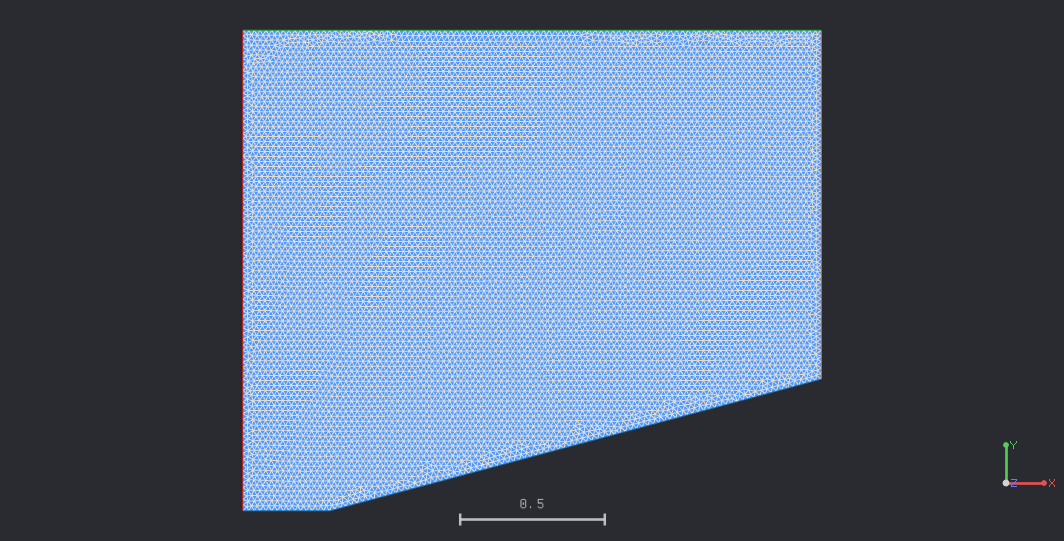
| Mesh | Unstructured triangular mesh; 8,789 nodes |
6 Boundary and Initial Conditions
| Item | Setting |
|---|---|
Wall (wall) |
Free-slip inviscid wall on the flat entry section and wedge surface |
Inlet (inlet) |
Supersonic farfield inflow; M=2.5, p=101325 Pa, T=288.15 K, zero angle of attack |
Outlet and top boundary (outlet, top) |
Supersonic pressure outlet (supersonic: true); interior state extrapolated without imposing back pressure |
7 Numerical Methods
| Item | Setting |
|---|---|
| Convective schemes | AUSM, AUSM+up2, AUSM+up, HLLC, JST, Roe, SLAU2, and SLAU (compared below) |
| Spatial method | Green–Gauss gradients with Venkatakrishnan limiter |
| Pseudo-time integration | Implicit; prescribed CFL schedule from 1 to 5 |
| Convergence targets | target_residual=-12, residual_reduction=8 |
8 Results
The Roe solution captured the attached oblique shock and the uniform post-shock region expected for this inviscid flow.
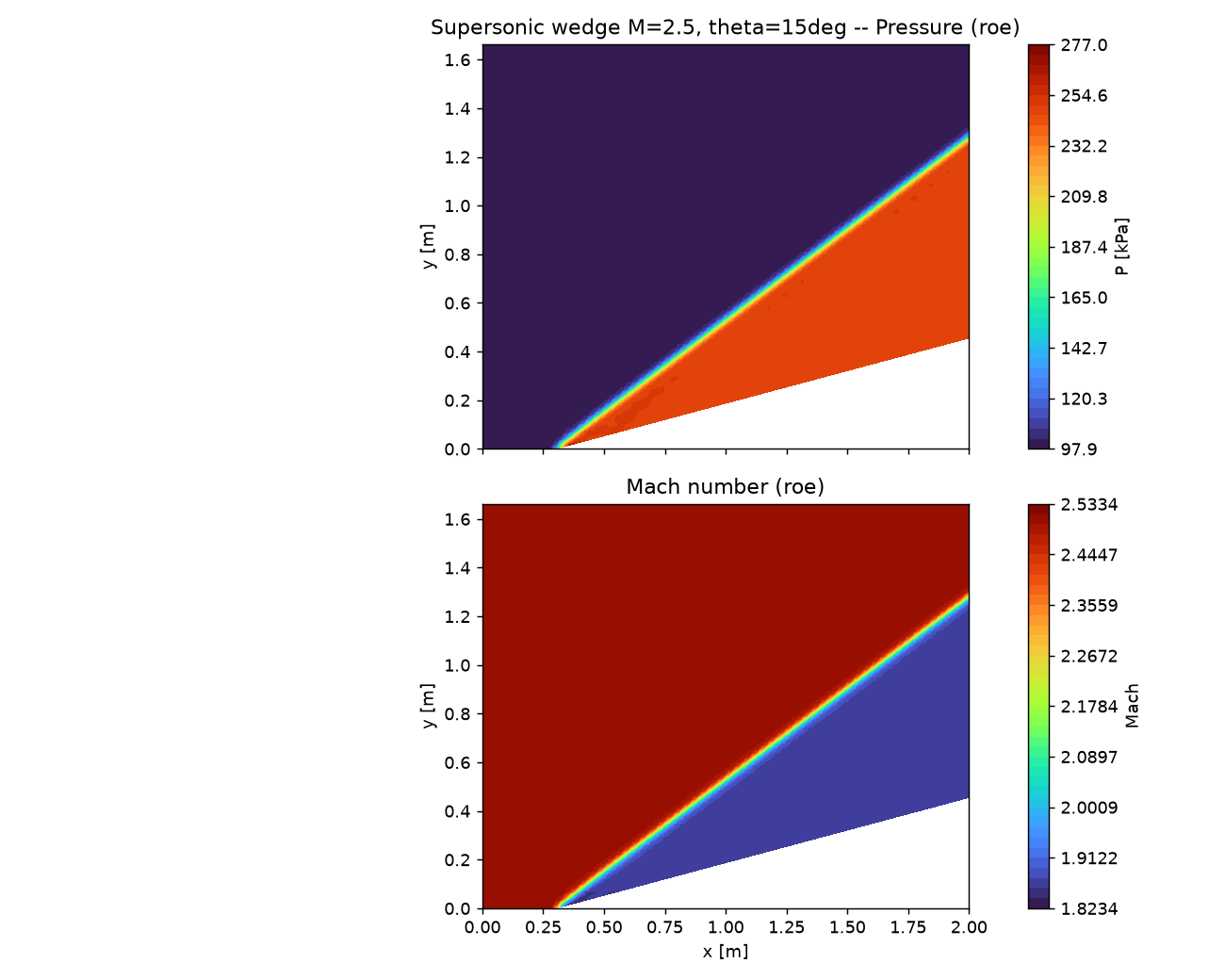
Eight convective schemes were evaluated on the same mesh and boundary conditions. All reached the specified convergence criterion. The post-shock state was sampled near the wall at x≈1.5 m, and the freestream state was sampled near the inlet. Their pressure ratio and the downstream Mach number were compared with the exact solution. All eight schemes reached the convergence criterion within 849–1,080 iterations.
| Scheme | p_2/p_1 |
Error in p_2/p_1 |
M_2 |
Error in M_2 |
|---|---|---|---|---|
| AUSM | 2.46752 | +0.0008% | 1.86655 | −0.372% |
| AUSM+up2 | 2.46750 | −0.0001% | 1.86539 | −0.434% |
| AUSM+up | 2.46744 | −0.0025% | 1.86402 | −0.507% |
| HLLC | 2.46746 | −0.0017% | 1.86528 | −0.440% |
| JST | 2.46729 | −0.0086% | 1.87445 | +0.049% |
| Roe | 2.46749 | −0.0003% | 1.86451 | −0.481% |
| SLAU2 | 2.46747 | −0.0012% | 1.86295 | −0.564% |
| SLAU | 2.46744 | −0.0023% | 1.86152 | −0.641% |
The pressure-ratio error was below 0.01% for every scheme, and the downstream-Mach error was below 0.7%.
9 Conclusions and Applicable Scope
- Wake CFD reproduced the exact pressure jump for the attached oblique shock to within 0.01% across the tested schemes.
- The downstream Mach number agreed with the exact solution to within 0.7%.
- The evaluation covered a single attached shock in steady, two-dimensional inviscid flow at
M=2.5and a 15° wedge angle, using eight schemes on the same 8,789-node mesh.