Laminar Cylinder Vortex Shedding — Time Integration and Precision Comparison
Temporal order of accuracy of implicit dual-time BDF1/BDF2 against explicit RK4, and FP32/FP64 arithmetic precision
1 Run Provenance and Artifacts
| Item | BDF1/BDF2 Δt sweep |
SLAU2 FP64 / FP32 |
|---|---|---|
| Solver | DBNS | DBNS |
| Compute device | CPU | GPU |
| Parallel execution | 4 MPI ranks | 1 MPI rank |
| Arithmetic precision | FP64 | FP64 / FP32 |
1.1 Downloadable Files
Not yet available. Standalone input decks and solver result files for this case are planned for a future release.
2 Verification Objective
The time-step study assessed the temporal accuracy of implicit dual-time BDF1 and BDF2 for unsteady laminar flow around a cylinder and vortex shedding in its wake. Successively smaller physical time steps were used to compare the results with the explicit-RK4 numerical reference and the observed temporal orders with the theoretical first and second orders. The BDF study held the mesh, physical conditions, and spatial discretization fixed across five time steps from T/32 to T/512, where T is the shedding period.
The explicit-RK4 case provided the numerical reference. It used the same mesh and physical conditions with a physical step of approximately 4.29×10^-6 s.
A separate pair of runs for the same laminar-cylinder problem compared FP64 and FP32 arithmetic using integrated force coefficients, residual levels, and elapsed time.
3 Reference Solution and Data
3.1 Numerical Reference
The explicit-RK4 case provides the independent time-integration reference for this Re_D=100 Kármán vortex street: St=0.1661, mean C_D=1.3473, and C_L amplitude 0.3327. The same mesh and physical conditions are used here for the BDF1/BDF2 time-step sweep.
4 Simulation Conditions
| Item | Setting |
|---|---|
Re_D |
100 |
| Mach | 0.05 |
| Reference state | ISA sea level, U=17.0387 m/s (as in the explicit-RK4 case) |
| Total simulated time | BDF study: 12 s per run; precision comparison: 40 s |
| Readout window | BDF study: t=6→12 s (16 cycles); precision comparison: t=8→40 s |
5 Mesh
| Item | Setting |
|---|---|
| BDF study geometry / mesh | Same as the explicit-RK4 case — 52,428 cells, 1.67% blockage |
6 Boundary and Initial Conditions
The BDF time-step study used the following conditions.
| Item | Setting |
|---|---|
Cylinder surface (cylinder) |
No-slip, adiabatic wall |
Outer boundary (farfield) |
Farfield with M=0.05, p=101325 Pa, T=288.15 K, zero angle of attack |
| Initial field | Uniform flow (uniform); M=0.05, p=101325 Pa, T=288.15 K, directed along +x |
Each BDF run started from uniform flow and developed its own vortex street.
7 Numerical Methods
| Item | Setting |
|---|---|
| BDF study spatial method | SLAU2, second order, weighted least-squares gradient, no limiter; corrected average viscous gradient (avg_grad_corrected) |
| Time integration | Implicit dual-time BDF1 / BDF2; pseudo-time CFL=30 (constant, does not affect the physical step) |
| Δt sweep | T/32, T/64, T/128, T/256, T/512 (T=0.353341 s, from the explicit-RK4 case’s measured St) |
| BDF inner iteration | Maximum 100 iterations, six-order residual-reduction target; FGMRES/DILU, maximum 50 linear iterations, tolerance 0.001 |
| FP64/FP32 runs | SLAU2 dual-time integration; Δt=0.001 s, pseudo-time CFL=9, measured inner depth of 11 iterations |
8 Results
8.1 Comparison with the numerical reference
At the finest step (Δt=T/512), the BDF2 St and mean drag matched the RK4 reference to the displayed precision; the lift-amplitude difference was −0.03%:
| Metric | BDF2 (Δt=T/512) |
Explicit-RK4 reference | Deviation |
|---|---|---|---|
St |
0.1661 | 0.1661 | 0.00% |
Mean C_D |
1.3473 | 1.3473 | 0.00% |
C_L amplitude |
0.3326 | 0.3327 | −0.03% |
At Δt=T/512, BDF1 retained the following differences from the reference:
| Metric | BDF1 (Δt=T/512) |
Deviation from reference |
|---|---|---|
St |
0.1645 | −0.96% |
Mean C_D |
1.3359 | −0.85% |
C_L amplitude |
0.3152 | −5.26% |
8.2 Order of accuracy
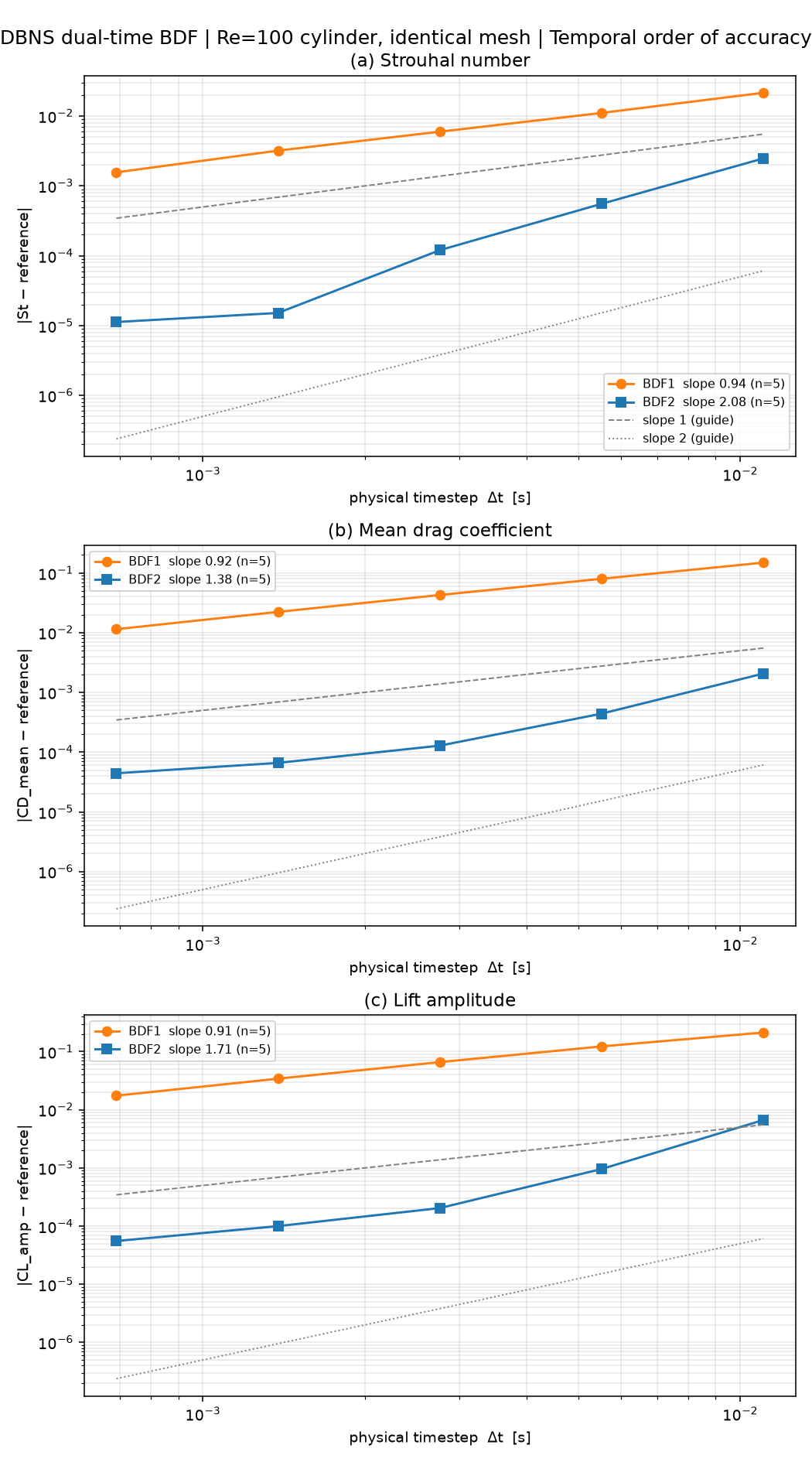
| Metric | BDF1 observed order |
BDF2 observed order |
Theoretical |
|---|---|---|---|
St |
0.94 | 2.08 | 1 / 2 |
Mean C_D |
0.92 | 1.38 | 1 / 2 |
C_L amplitude |
0.91 | 1.71 | 1 / 2 |
The fitted BDF1 orders were close to the theoretical first order for all three metrics. BDF2 gave an approximately second-order St trend (2.08), with lower fitted orders for mean C_D and C_L amplitude (1.38 and 1.71).
At Δt=T/128, the BDF2 mean C_D was 1.3472, close to the RK4 reference of 1.3473. The fitted orders in the table characterize temporal convergence. The force-coefficient orders were below the theoretical second order.
For BDF1 at Δt=T/32, the drag/lift frequency ratio was 0.026, compared with approximately 2 for the other configurations. Excluding that point gave refitted BDF1 orders of 0.929 for St, 0.937 for mean C_D, and 0.938 for C_L amplitude, retaining the approximately first-order trend.
8.3 FP64 versus FP32
The FP64 and FP32 runs advanced to 40 s, and the comparison used t=8→40 s. Both runs had a measured inner depth of 11 iterations. Mean C_D was 1.3604 for FP64 and 1.3603 for FP32, a difference below 0.01%; both gave a C_L amplitude of approximately 0.335 and St=0.1670.
| Metric | FP64 | FP32 |
|---|---|---|
| Final flow residual (log₁₀) | −8.98 | −7.09 |
| Wall-clock time | 5.16 h | 2.75 h |
| Final linear iterations | 18 | 6 |
The final FP32 residual was approximately 1.9 orders higher, and its elapsed time was approximately 1.88 times shorter. The timing comparison also considered the measured linear-iteration counts.
9 Conclusions and Applicable Scope
- The observed BDF1 orders were
0.91–0.94across the three metrics, close to the theoretical first order. BDF2 gave2.08forSt,1.38for meanC_D, and1.71forC_Lamplitude. - At
Δt=T/512, BDF2 matched the RK4Stand meanC_Dto the displayed precision, with aC_L-amplitude difference of −0.03%. At the same step, the BDF1C_Lamplitude differed by −5.26%. - The BDF1
T/32drag/lift frequency ratio differed from the expected value of2. Excluding that point retained the approximately first-order fitted trend. - The separate FP64/FP32 pair differed by less than 0.01% in mean drag, with the final residuals and elapsed times reported above.
- The BDF study covered two-dimensional laminar cylinder flow at
Re_D=100andM=0.05on the52,428-cell mesh with SLAU2. The precision comparison used the separate run conditions documented above.
10 References
- Williamson, C. H. K., “Defining a Universal and Continuous Strouhal–Reynolds Number Relationship for the Laminar Vortex Shedding of a Circular Cylinder,” Physics of Fluids, 31(10), 1988, pp. 2742–2744.
- Henderson, R. D., “Details of the Drag Curve near the Onset of Vortex Shedding,” Physics of Fluids, 7(9), 1995, pp. 2102–2104.