Circular Couette Flow
Four-level grid convergence between a rotating inner cylinder and a stationary outer cylinder
1 Run Provenance and Artifacts
| Item | Value |
|---|---|
| Solver | PBNS, steady incompressible laminar flow, mixed precision |
| Compute device | CPU |
| Parallel execution | 1 MPI rank for 16 × 64 through 64 × 256; 4 ranks for 128 × 512 |
1.1 Downloadable Files
| File | Description | Format |
|---|---|---|
| Grid-convergence results | Iterations, velocity and pressure errors, and observed orders for the four meshes | CSV |
The input decks, meshes, raw solver fields, and analysis scripts are not yet available and are planned for a future release.
2 Verification Objective
Steady laminar flow between a rotating inner cylinder and a stationary outer cylinder was computed on four meshes. The PBNS tangential-velocity profile and radial pressure rise were compared with analytical solutions to assess whether their errors approached second-order spatial convergence as the mesh spacing was halved. The assessment also covered radial velocity and azimuthal variation.
3 Reference Solution and Data
3.1 Analytical Solution
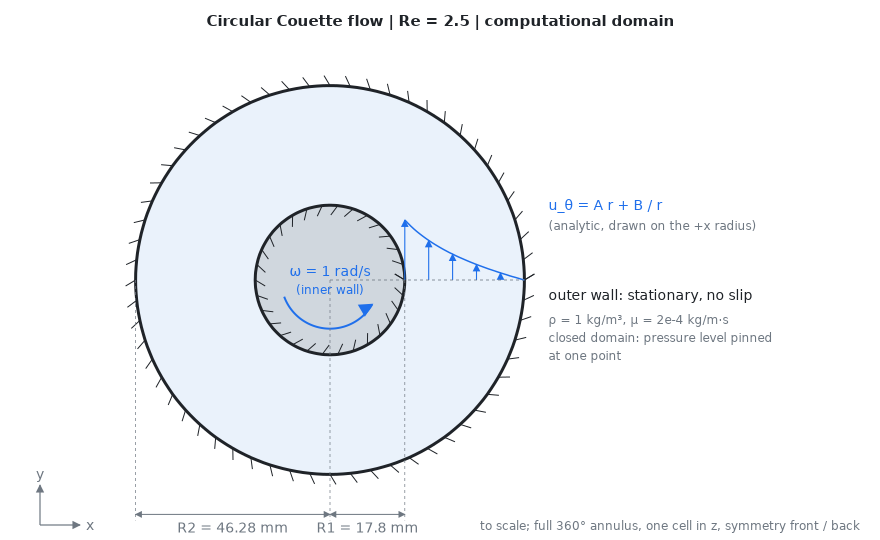
For inner radius \(R_1\), outer radius \(R_2\), and inner-wall angular speed \(\omega\), the tangential velocity follows White’s circular Couette solution:
\[ u_\theta(r) = Ar + \frac{B}{r}, \qquad A = -\frac{\omega R_1^2}{R_2^2-R_1^2}, \qquad B = \frac{\omega R_1^2R_2^2}{R_2^2-R_1^2}. \]
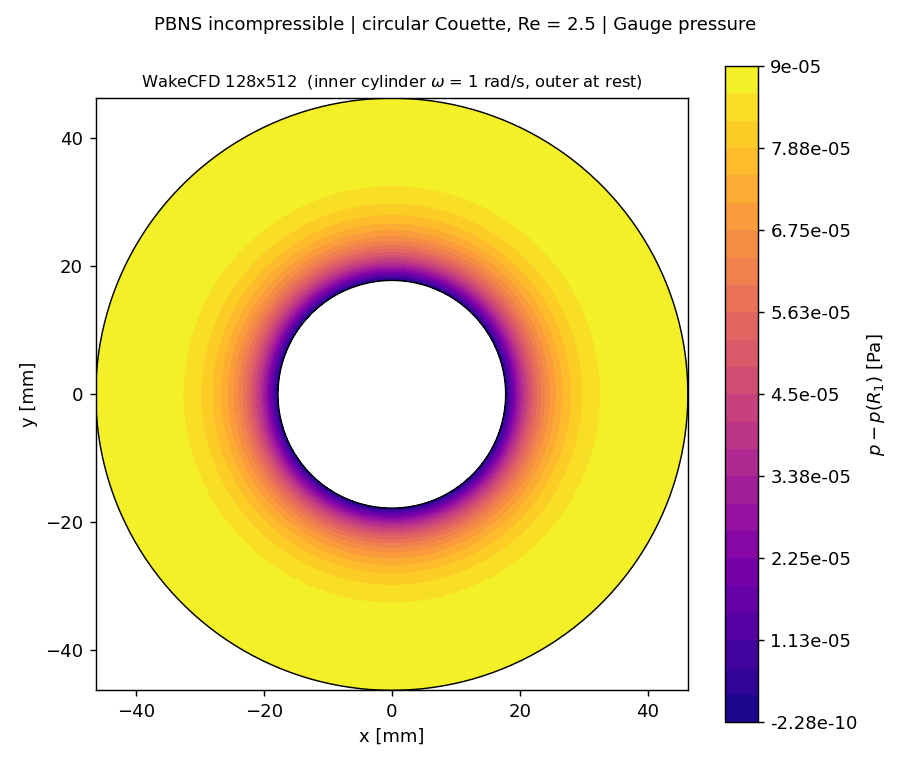
The analytical radial velocity is zero. Radial momentum balance gives \(dp/dr=\rho u_\theta^2/r\). Integrating between the walls gives \(p(R_2)-p(R_1)=9.0057\times10^{-5}\) Pa for these conditions. The pressure datum in the closed domain is arbitrary, so the comparison used the pressure difference between the walls.
Tangential-velocity errors were normalized by the inner-wall speed \(\omega R_1=0.0178\) m/s. This value remains finite at the stationary outer wall, where the analytical tangential velocity is zero.
4 Simulation Conditions
| Item | Setting |
|---|---|
| Geometry | Full 360° annulus; \(R_1=17.8\) mm, \(R_2=46.28\) mm |
| Flow | Steady, laminar, incompressible; energy equation off |
| Inner-wall angular speed | \(\omega=1\) rad/s about the positive \(z\) axis |
| Density | \(\rho=1\) kg/m³ |
| Dynamic viscosity | \(\mu=2\times10^{-4}\) Pa·s |
| Reynolds number | \(\rho\omega R_1(R_2-R_1)/\mu\approx2.53\) |
5 Mesh
A full-circle O-grid was extruded by 1 mm in \(z\) to form one layer of hexahedral cells. The radial × azimuthal resolutions were 16 × 64, 32 × 128, 64 × 256, and 128 × 512. They contained 2,176, 8,448, 33,280, and 132,096 nodes, respectively. The radial cell spacing halved from 1.78 mm to 0.2225 mm. All four meshes used the same physical and numerical settings.
6 Boundary and Initial Conditions
| Boundary or field | Setting |
|---|---|
| Inner cylinder | Rotating no-slip wall; \(\omega=1\) rad/s about the origin and the \(+z\) axis |
| Outer cylinder | Stationary no-slip wall |
| Front and back planes | Symmetry; one extruded layer represents the two-dimensional solution |
| Initial field | Zero velocity, pressure 1 Pa, temperature 300 K; temperature not solved |
| Pressure datum | Automatically fixed at one point in the closed domain |
7 Numerical Methods
The calculations used the incompressible PBNS formulation with FGMRES and an AMG flow preconditioner. The linear solver allowed at most 50 iterations per solve with a tolerance of \(10^{-3}\). Steady pseudo-time marching used local CFL 20. The outer-iteration limit was 20,000, with a stopping target of scaled flow residual at or below \(10^{-10}\), or an absolute-residual indicator with log10 value at or below \(-15\). All four meshes reached the configured criterion in 79–899 iterations. A physical time-step study does not apply to this steady calculation.
8 Results
Nodes were grouped into rings by radius. Tangential velocity and pressure were averaged around each ring. Tangential-velocity error was normalized by \(\omega R_1\). Pressure rise was the difference between the outer- and inner-wall ring-mean pressures.
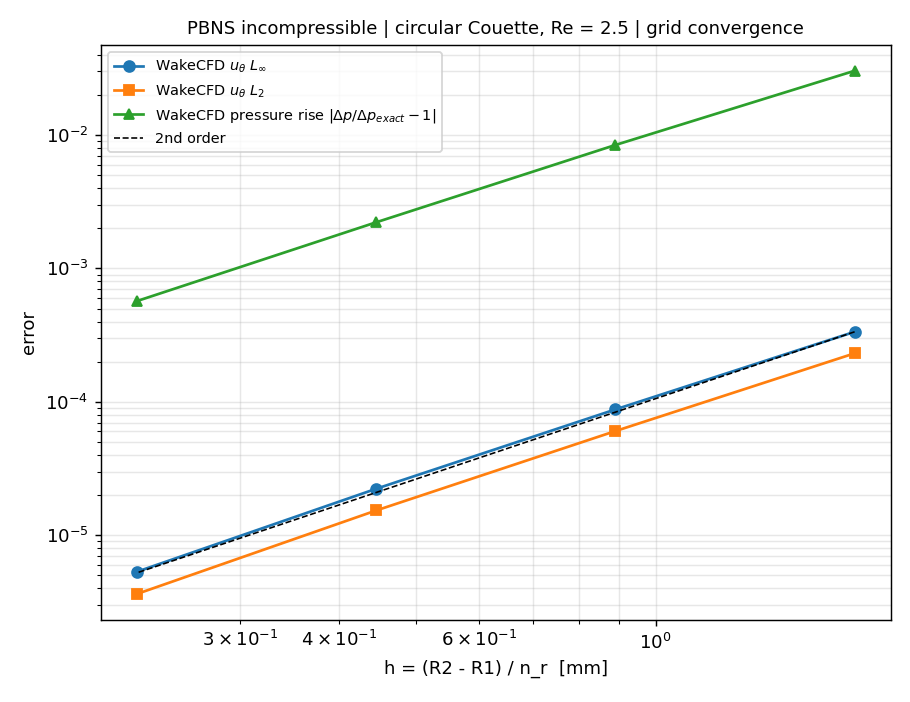
| Mesh | Nodes | Iterations | Maximum tangential-velocity error / \(\omega R_1\) | Observed order | Pressure-rise error | Observed order |
|---|---|---|---|---|---|---|
| 16 × 64 | 2,176 | 79 | \(3.349\times10^{-4}\) | — | \(-3.028\)% | — |
| 32 × 128 | 8,448 | 175 | \(8.773\times10^{-5}\) | 1.93 | \(-0.841\)% | 1.85 |
| 64 × 256 | 33,280 | 396 | \(2.231\times10^{-5}\) | 1.97 | \(-0.222\)% | 1.92 |
| 128 × 512 | 132,096 | 899 | \(5.333\times10^{-6}\) | 2.07 | \(-0.057\)% | 1.96 |
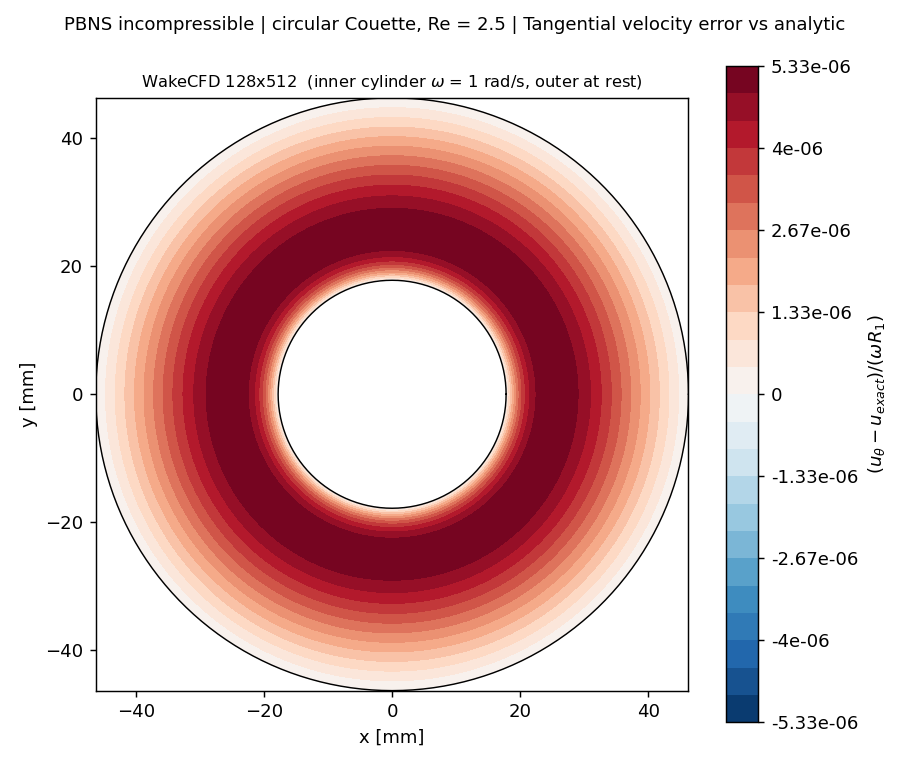
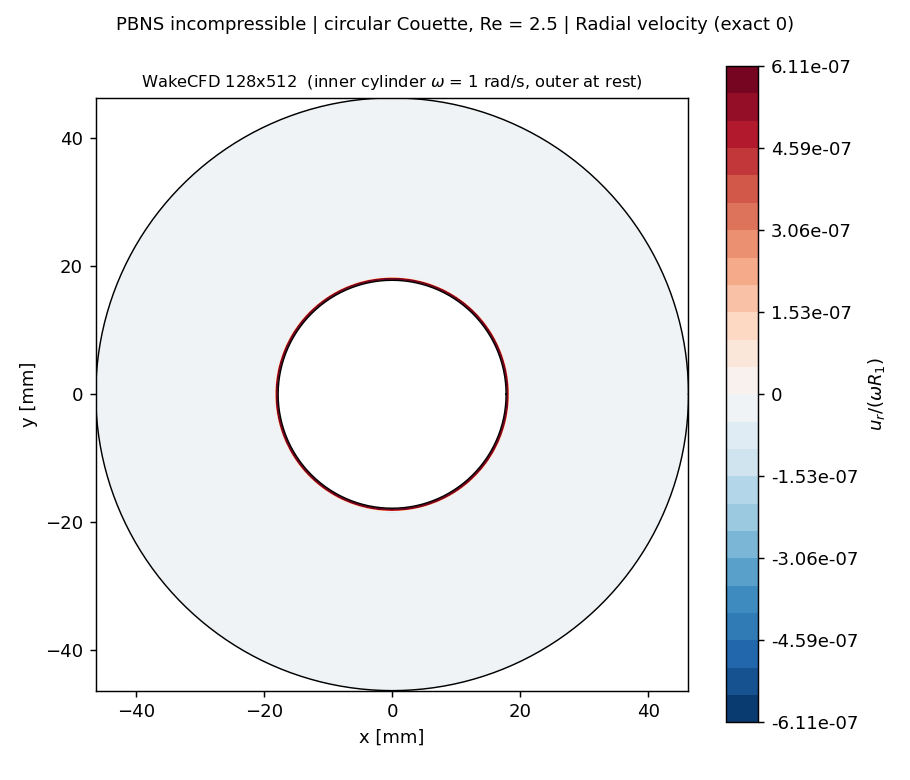
Both tangential-velocity and pressure-rise errors decreased with refinement. The observed orders between the two finest meshes were 2.07 and 1.96, respectively, close to second-order spatial convergence. Maximum radial velocity normalized by \(\omega R_1\) also decreased from \(2.01\times10^{-4}\) to \(6.20\times10^{-7}\).
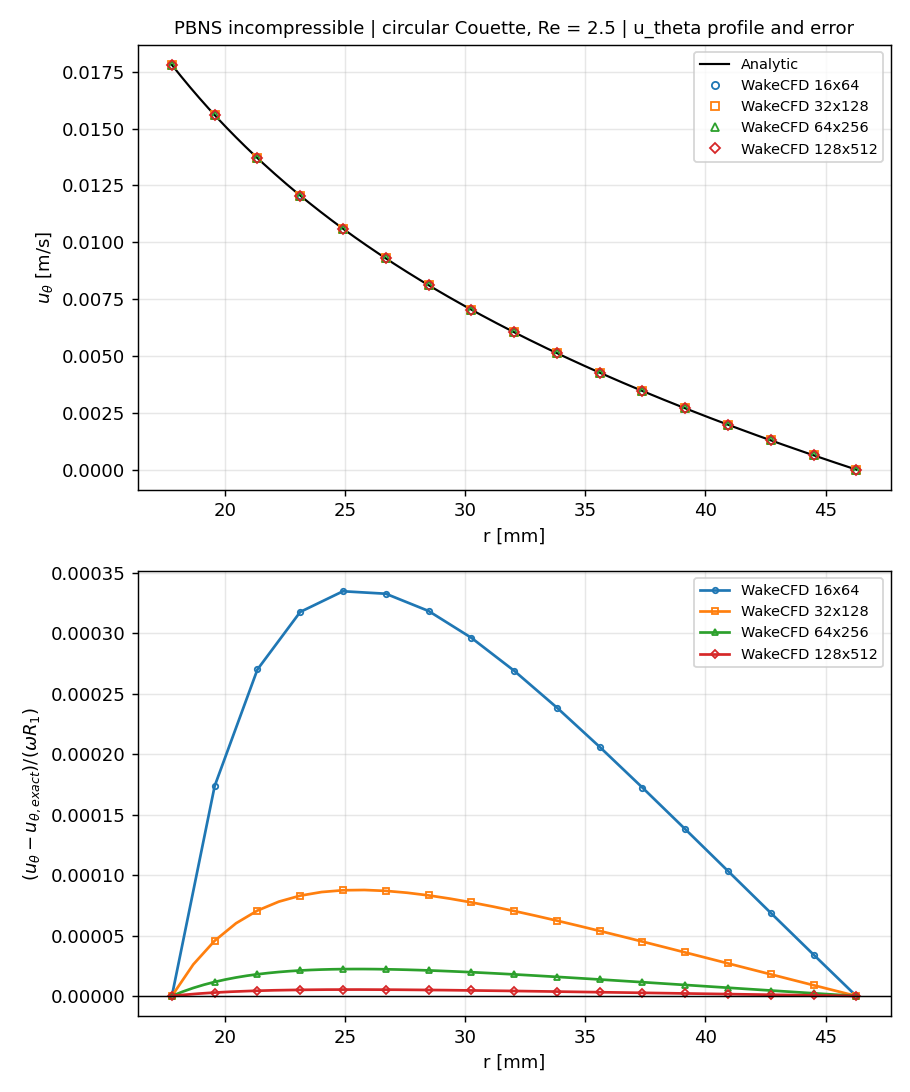
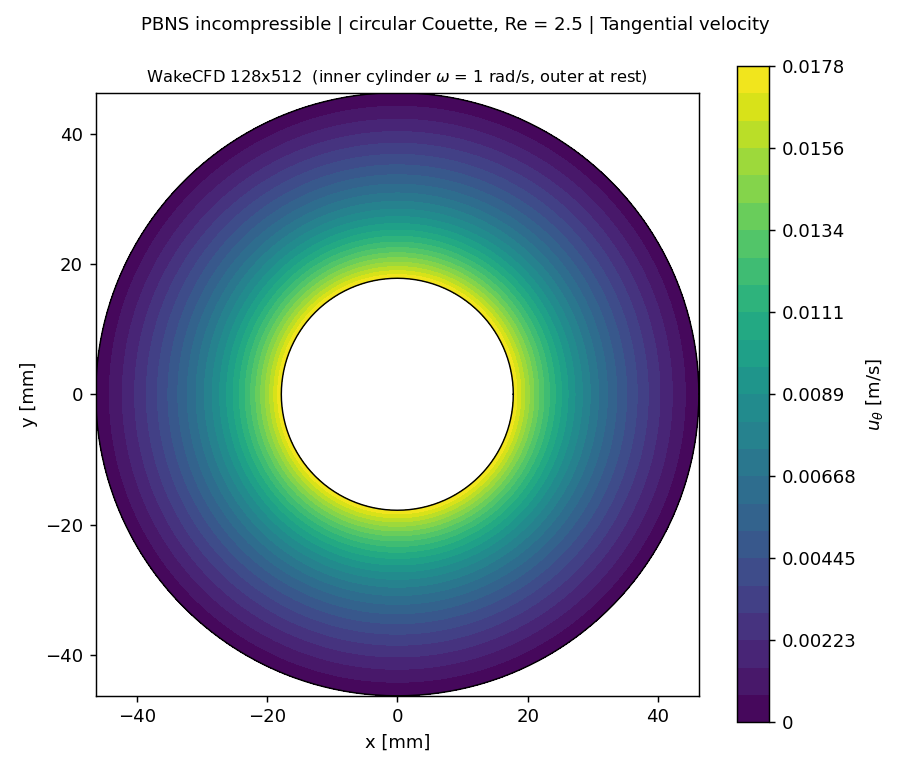
On the finest mesh, tangential velocity and pressure on the \(z=0\) plane show axisymmetric distributions. Tangential-velocity error is largest near the inner part of the gap and decreases toward both walls.
9 Conclusions and Applicable Scope
All four calculations reached the configured residual criterion. Tangential-velocity and pressure-rise errors decreased with refinement, and their observed orders approached two. These results apply to the stated geometry, material properties, rotation rate, boundary conditions, and steady laminar regime.
10 References
- White, F. M. Viscous Fluid Flow. McGraw-Hill, 1991, Section 3-2.3.