3D Sphere Bow Shock — Stand-off Distance Validation
Shock stand-off distance and stagnation pressure against the Billig (1967) correlation and the Rayleigh-Pitot relation, on a mesh-refinement sequence
1 Run Provenance and Artifacts
| Item | Value |
|---|---|
| Solver | DBNS |
| Parallel execution | 1 MPI rank (coarse); 4 MPI ranks (adapt3, adapt4) |
| Arithmetic precision | FP64 |
1.1 Downloadable Files
Not yet available. Standalone input decks and solver result files for this case are planned for a future release.
2 Validation Objective
The detached bow shock ahead of a sphere in supersonic flow was computed using Wake CFD’s 3D Euler solver. The shock stand-off distance was validated against the empirical Billig (1967) correlation. The stagnation pressure was verified against the theoretical Rayleigh–Pitot relation, derived from a normal shock followed by isentropic deceleration. Both quantities were evaluated across an unstructured 3D tetrahedral mesh-refinement sequence.
3 Reference Solution and Data
| Item | Setting |
|---|---|
| Reference | Billig (1967) shock stand-off correlation; Rayleigh-Pitot normal-shock relation |
4 Simulation Conditions
| Item | Setting |
|---|---|
| Geometry | Sphere, radius R = 0.1 m; farfield boundary at 0.6 m (= 6R); half-domain (z≥0 symmetry plane) |
| Analysis | Steady, inviscid (Euler), ideal-gas air (γ=1.4) |
| Freestream | M = 3.0, p = 101,325 Pa, T = 288.15 K, flow along −x; stagnation point at x=+R; zero angle of attack |
Billig correlation (sphere, ideal gas): Δ/R = 0.143·exp(3.24/M∞²), giving Δ/R = 0.20497 and Δ = 20.497 mm at M∞=3.
Stagnation-streamline normal-shock relation gives the post-shock stagnation pressure p₀,₂ directly comparable to the CFD wall stagnation-point pressure: p₀,₂ = 1,222,077 Pa at M∞=3.
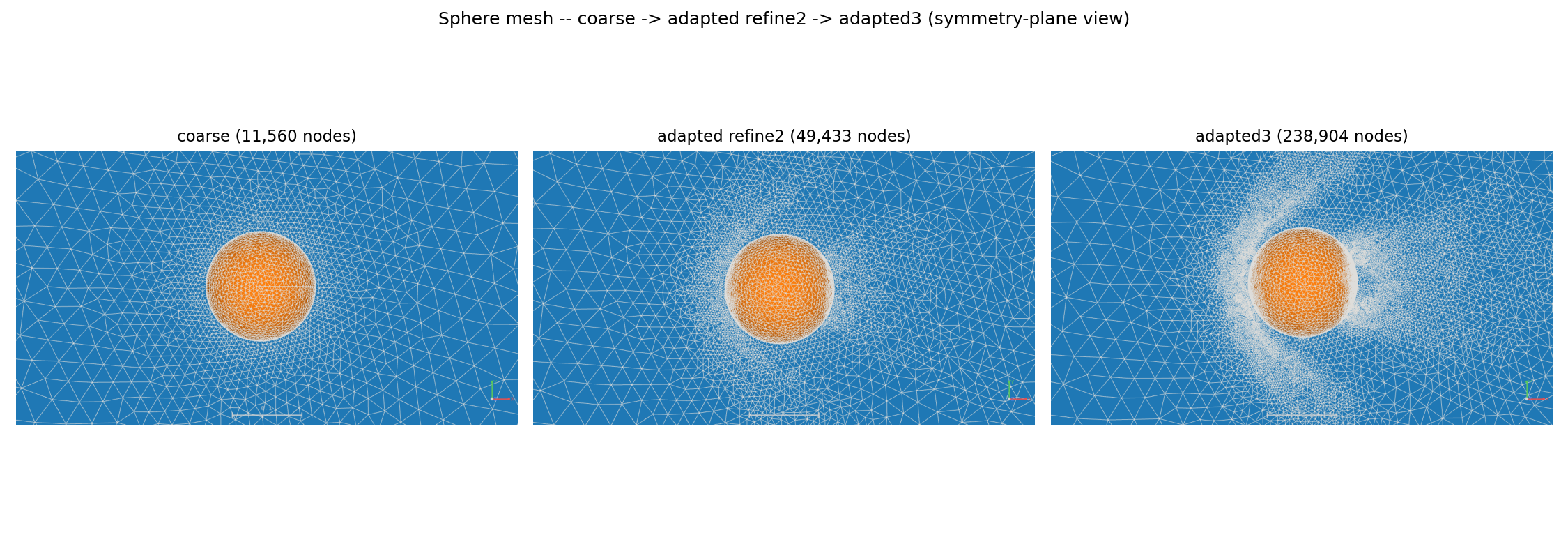
5 Mesh
| Item | Setting |
|---|---|
| Mesh sequence | Unstructured tetrahedral; coarse (uniform, 11,560 nodes) refined toward a solution-adaptive, shock-band-targeted sequence: adapt3 (238,904 nodes) and adapt4 (656,764 nodes) |
6 Boundary and Initial Conditions
| Item | Setting |
|---|---|
Sphere surface (wall) |
Free-slip inviscid wall |
Farfield (farfield) |
Single characteristic-based boundary covering upstream and downstream regions; M=3.0, p=101325 Pa, T=288.15 K, flow along −x |
Symmetry plane (symmetry) |
Symmetry at z=0 |
The adapt3 calculation started from the preceding refined-mesh solution interpolated onto the new mesh. The adapt4 calculation restarted from the adapt3 solution interpolated onto the finer mesh.
7 Numerical Methods
| Item | Setting |
|---|---|
| Convective scheme | HLLC |
| Gradient method | Green–Gauss with Venkatakrishnan limiter |
| Pseudo-time integration | Implicit, fixed CFL 5.0 |
| Residual targets | residual_absolute=-10, residual_reduction=6 |
8 Results
A clearly detached bow shock formed at each mesh resolution, consistent with the expected structure of blunt-body supersonic flow.
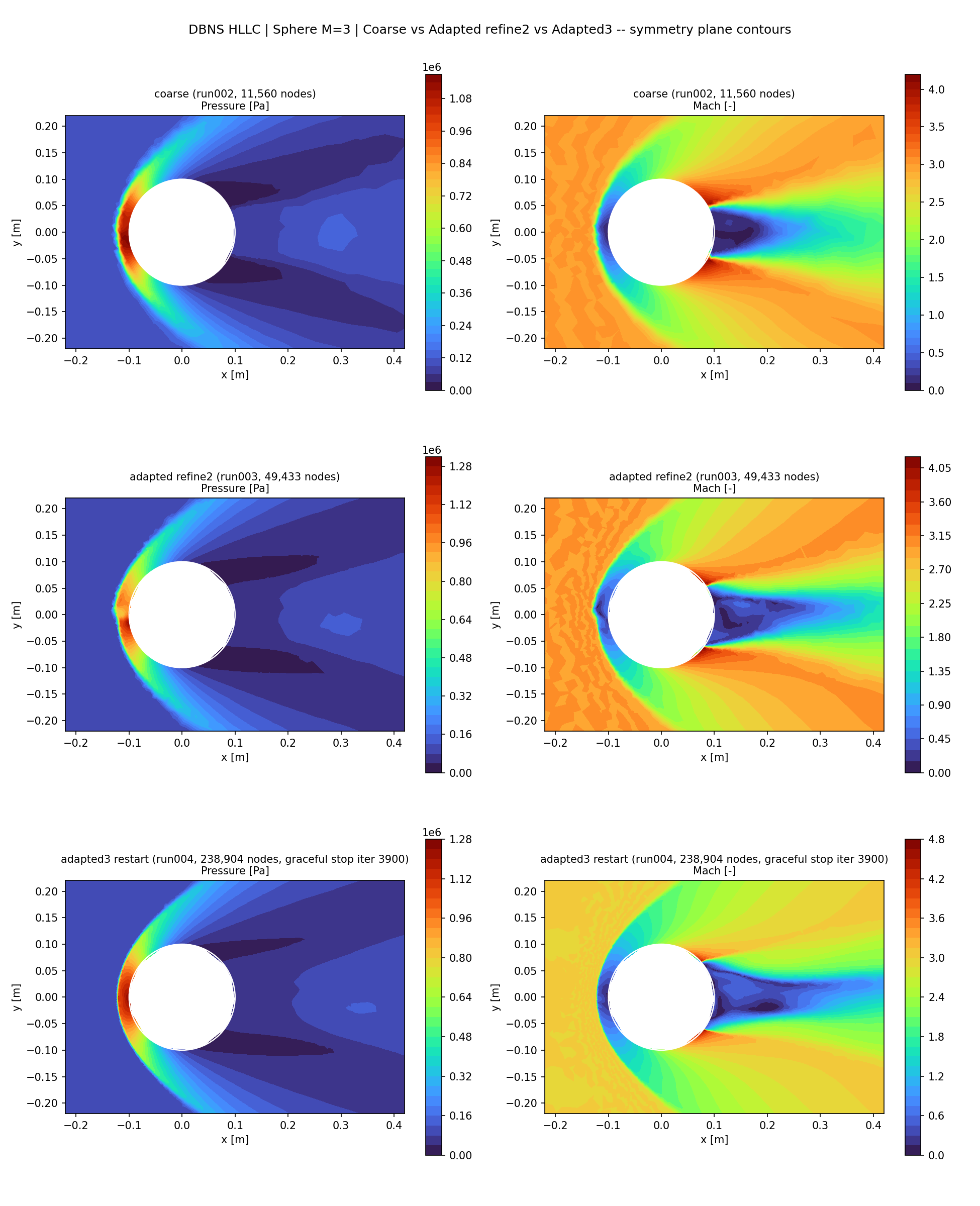
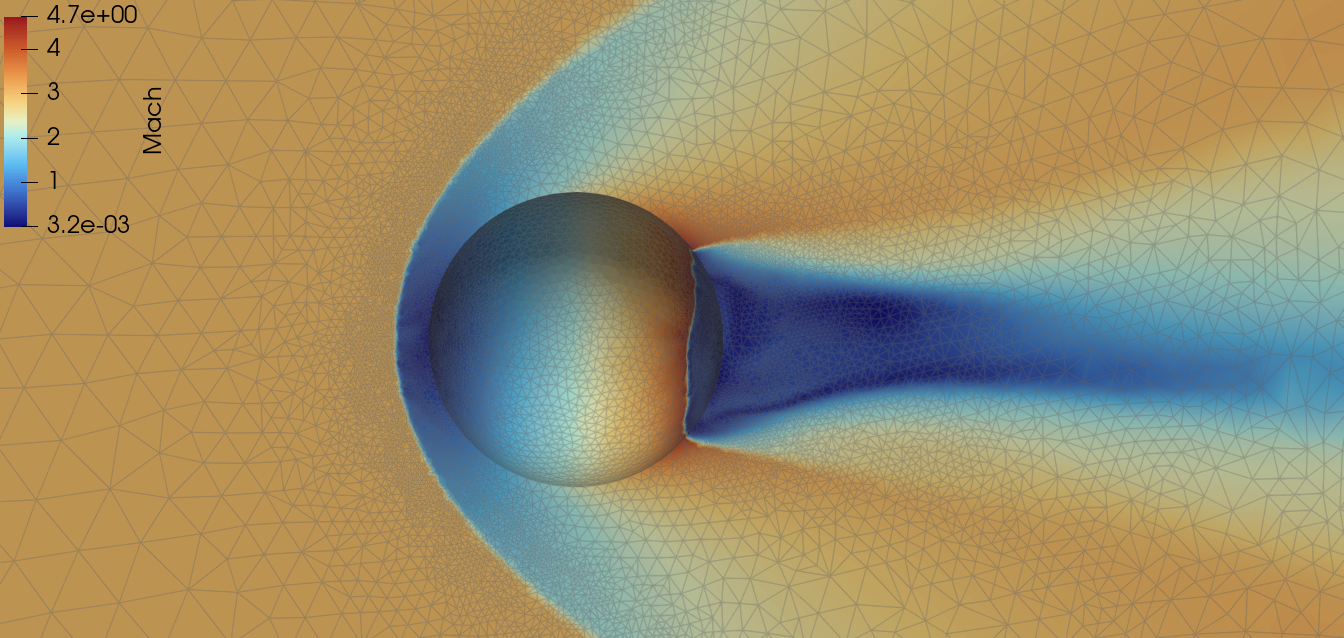
The figures show coarse, the intermediate refine2 mesh, and adapt3. The quantitative comparison below gives the stand-off distance and stagnation pressure on the coarse, adapt3, and further-refined adapt4 meshes alongside the Billig and Rayleigh–Pitot references.
| Mesh | Nodes | Stand-off distance Δ |
Error vs. Billig | Stagnation pressure p₀,₂ |
Error vs. Rayleigh-Pitot |
|---|---|---|---|---|---|
| coarse | 11,560 | 23.18 mm | +13.1% | 1,102,994 Pa | −9.7% |
| adapt3 | 238,904 | 21.41 mm | +4.5% | 1,222,333 Pa | +0.0% |
| adapt4 | 656,764 | 21.73 mm | +6.0% | 1,200,418 Pa | −1.8% |
Refining from coarse to adapt3 reduced the stand-off-distance difference from +13.1% to +4.5% and the stagnation-pressure difference from −9.7% to +0.0%. With further refinement to adapt4, the differences increased to +6.0% and −1.8%, respectively. Neither metric showed monotonic error reduction across this sequence.
The coarse calculation reached the six-order residual-reduction criterion at iteration 1,885. The residuals on adapt3 and adapt4 oscillated at approximately −6.5 to −7.2 and −6.8 to −7.05, respectively, without reaching the residual targets. We stopped adapt3 at iteration 3,900 after checking the stability of flow-field extrema, and adapt4 at iteration 6,700 after checking the force-coefficient history. Both refined calculations ended by user-requested stop; the table reports the stand-off distance and stagnation pressure at those endpoints.
9 Conclusions and Applicable Scope
- The 3D Euler calculations reproduced the detached bow shock ahead of the sphere. On
adapt3, the stand-off distance differed from the Billig correlation by +4.5%, and the stagnation pressure differed from the Rayleigh–Pitot theoretical value by +0.0%. - On
adapt4, the differences were +6.0% and −1.8%, respectively. The sequence did not demonstrate monotonic mesh convergence. The refined-mesh comparison used the results at the residual levels and termination points given above. - The evaluation covered steady, inviscid, ideal-gas flow at
M=3.0and zero angle of attack over a sphere of radius0.1 m, comparing stand-off distance and stagnation pressure on the three reported meshes.
10 References
- Billig, F. S., “Shock-Wave Shapes Around Spherical- and Cylindrical-Nosed Bodies,” Journal of Spacecraft and Rockets, 4(6), 1967, pp. 822–823.