Forward-Facing Step — Supersonic Shock-System Verification
Qualitative comparison with the Woodward–Colella benchmark and a global mass-balance check
1 Run Provenance and Artifacts
| Item | Value |
|---|---|
| Solver | DBNS |
| Executable | wake_2d_fp64.exe |
| Arithmetic precision | FP64 |
1.1 Downloadable Files
Not yet available. Standalone input decks and solver result files for this case are planned for a future release.
2 Verification Objective
The Mach 3 forward-facing-step flow was computed, and its characteristic inviscid shock structure was compared with the published benchmark. The inlet and outlet mass fluxes were integrated to assess global mass conservation.
The setup followed the forward-facing-step configuration of Emery and of Woodward and Colella.
3 Reference Solution and Data
3.1 Numerical Reference
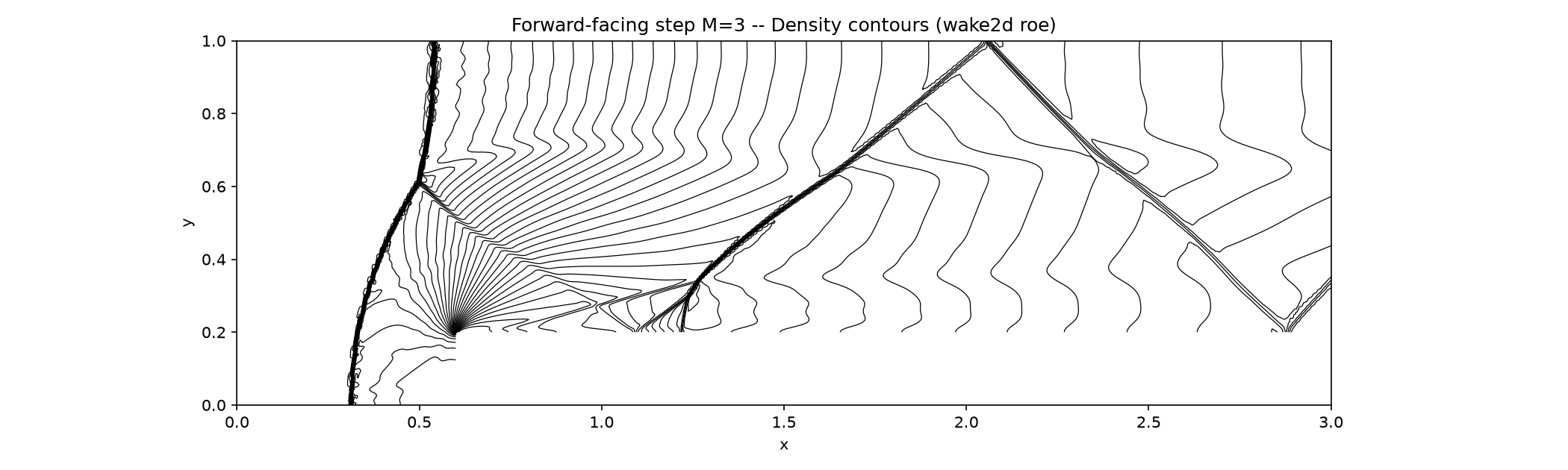
The forward-facing-step calculations of Emery and of Woodward and Colella provide the numerical reference (see References). The qualitative comparison used the density-contour pattern in Fig. 1 of Woodward and Colella (1984) to assess the computed shock structure.
4 Simulation Conditions
| Item | Setting |
|---|---|
| Geometry | 2D channel, 3.0 × 1.0 m; step at x=0.6 m with height 0.2 m |
| Physics | Steady Euler equations, ideal-gas air (gamma=1.4) |
| Freestream | M=3.0, p=101325 Pa, T=288.15 K, zero angle of attack |
5 Mesh
| Item | Setting |
|---|---|
| Mesh | Unstructured triangular mesh; 53,565 nodes; inside step corner rounded to a radius of 0.003 m |
6 Boundary and Initial Conditions
| Item | Setting |
|---|---|
Wall (wall) |
Free-slip inviscid wall on the channel walls, step riser, and step surface |
Inlet (inlet) |
Supersonic farfield inflow; M=3.0, p=101325 Pa, T=288.15 K, zero angle of attack |
Outlet (outlet) |
Supersonic pressure outlet (supersonic: true); interior state extrapolated without imposing back pressure |
7 Numerical Methods
| Item | Setting |
|---|---|
| Convective scheme | Roe with Harten–Hyman entropy fix (δ=0.05) |
| Spatial method | Green–Gauss gradients with Venkatakrishnan limiter |
| Pseudo-time integration | Implicit; prescribed CFL schedule from 1 to 3 |
| Convergence targets | target_residual=-10, residual_reduction=6; maximum 40,000 iterations |
8 Results
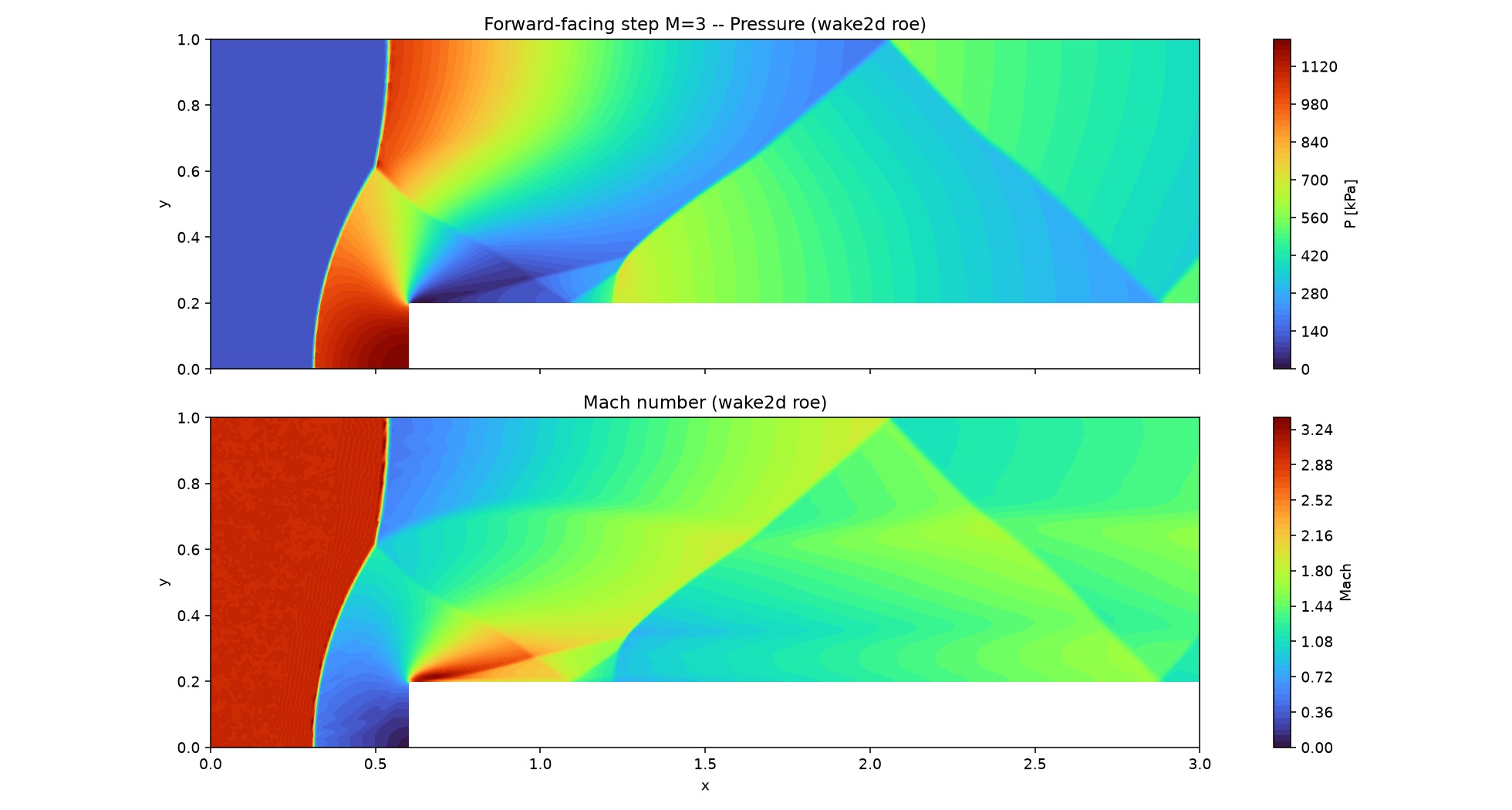
The calculation reached the six-order residual-reduction criterion at iteration 16,196. The density contours reproduced the benchmark’s characteristic features: a bow shock upstream of the step, an expansion fan at the step corner, a reflected shock from the upper wall, and a secondary reflection downstream.
As a quantitative consistency check, the integrated inlet mass flow is approximately 1250.59 kg/(s·m) and the outlet mass flow is approximately 1250.94 kg/(s·m), excluding the blocked region below the step. The resulting mass-flow difference is 0.03%.
9 Conclusions and Applicable Scope
- The computed shock structure was qualitatively consistent with the established Woodward–Colella forward-facing-step benchmark.
- The global inlet/outlet mass-flow mismatch is 0.03% for the reported steady solution.
- The evaluation covered steady, two-dimensional inviscid flow at
M=3.0using Roe with the specified entropy fix on the 53,565-node mesh. The comparison covered shock structure and global mass balance.
10 References
- Emery, A. F., An Evaluation of Several Differencing Methods for Inviscid Fluid Flow Problems, Journal of Computational Physics, 2(3), 306–331, 1968.
- Woodward, P., and Colella, P., The Numerical Simulation of Two-Dimensional Fluid Flow with Strong Shocks, Journal of Computational Physics, 54(1), 115–173, 1984.