Lid-Driven Cavity Flow
Steady laminar flow at Reynolds numbers 100, 400, 1000, and 3200
1 Run Provenance and Artifacts
| Item | Value |
|---|---|
| Solver | PBNS, steady incompressible laminar flow |
| Compute device and precision | CPU, mixed precision |
| Parallel execution | 8 MPI ranks |
1.1 Downloadable Files
| File | Description | Format |
|---|---|---|
| Run summary | Reynolds number, mesh size, convergence status, iterations, and centerline error for all 14 runs | CSV |
The input decks, meshes, and raw solver fields are not yet available and are planned for a future release.
2 Verification Objective
Steady flow in a square lid-driven cavity was computed with the incompressible pressure-based solver at \(Re=100\), 400, 1000, and 3200. The centerline velocity profiles were compared with the numerical reference solution of Ghia, Ghia, and Shin (1982). The assessment covered mesh refinement and residual convergence. Because the reference is a numerical solution, this case is classified as verification.
3 Reference Solution and Data
3.1 Numerical Reference
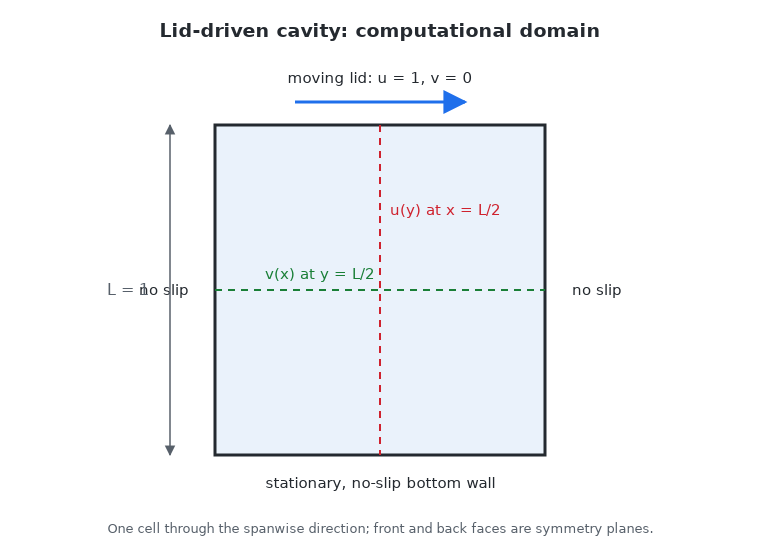
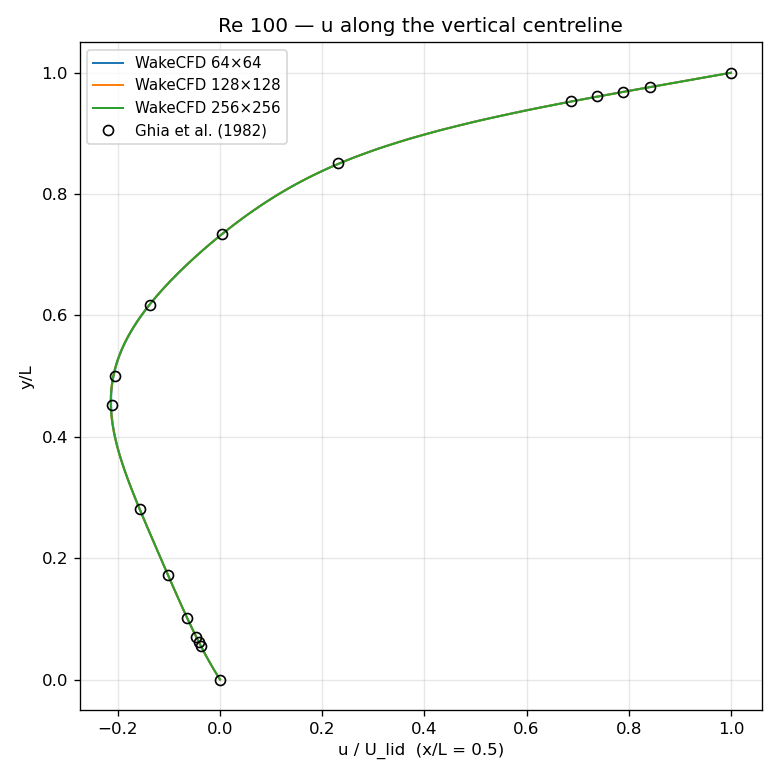
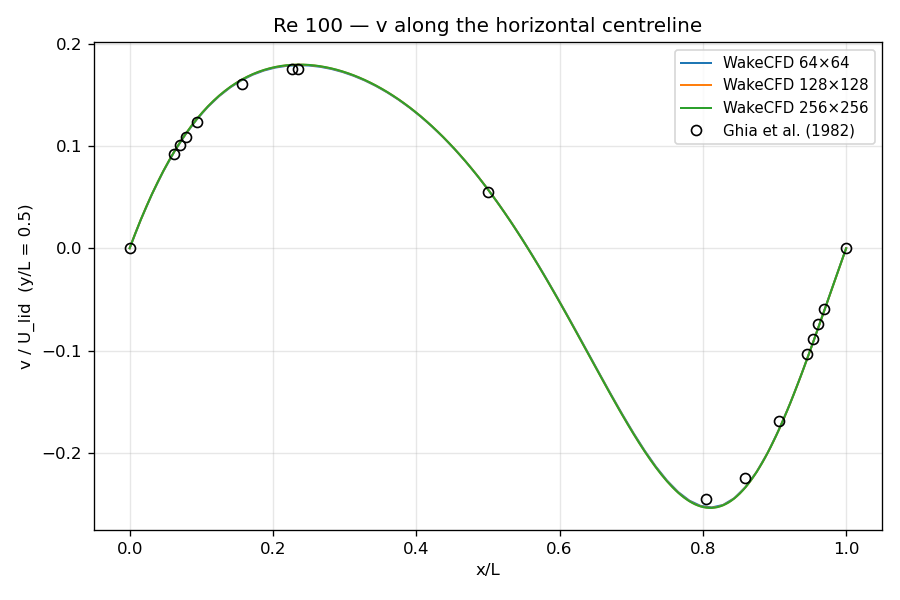
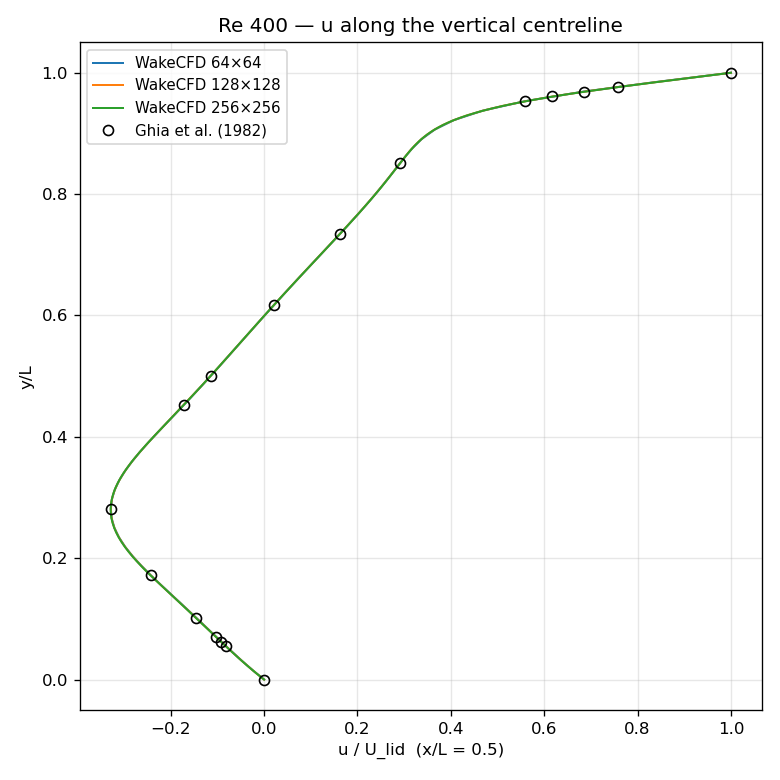
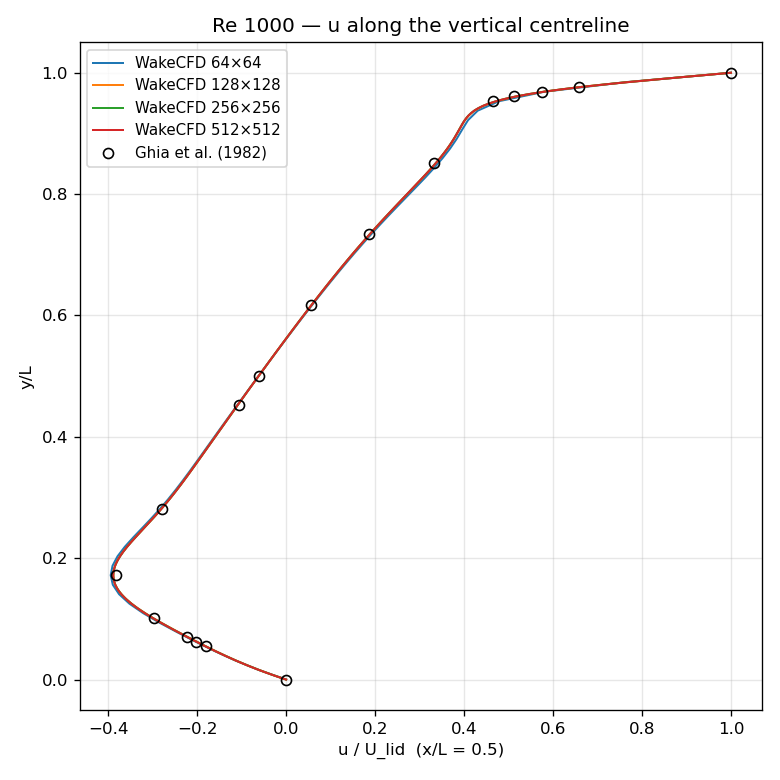
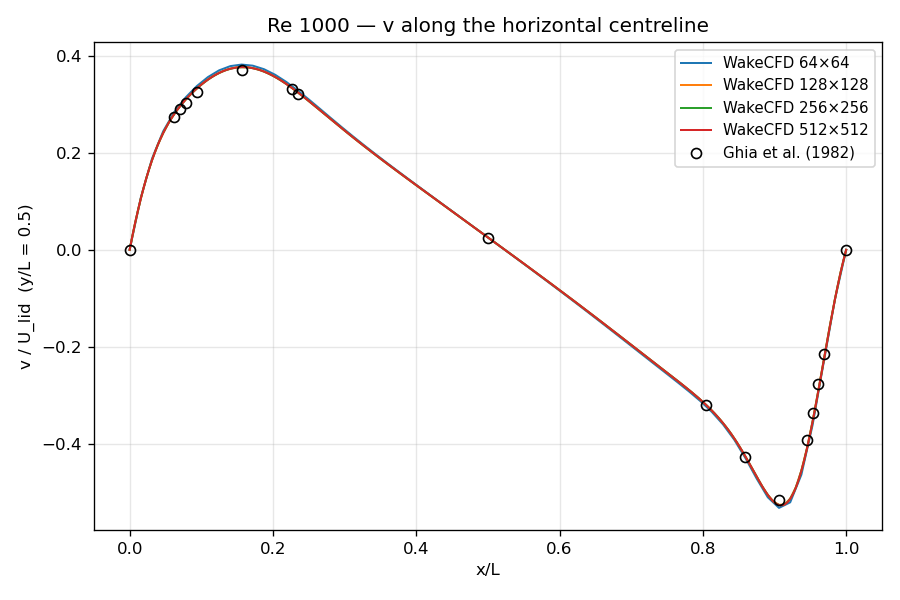
Ghia, Ghia, and Shin (1982) tabulated velocity along the vertical and horizontal centerlines of a two-dimensional lid-driven cavity. The normalized horizontal velocity \(u/U_\mathrm{lid}\) at \(x/L=0.5\) and vertical velocity \(v/U_\mathrm{lid}\) at \(y/L=0.5\) were compared with those tabulated points.
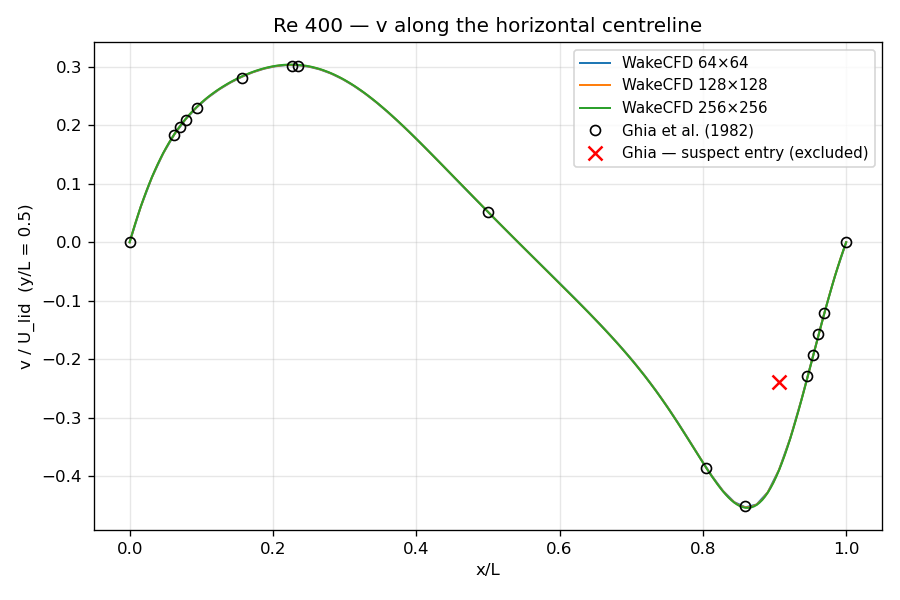
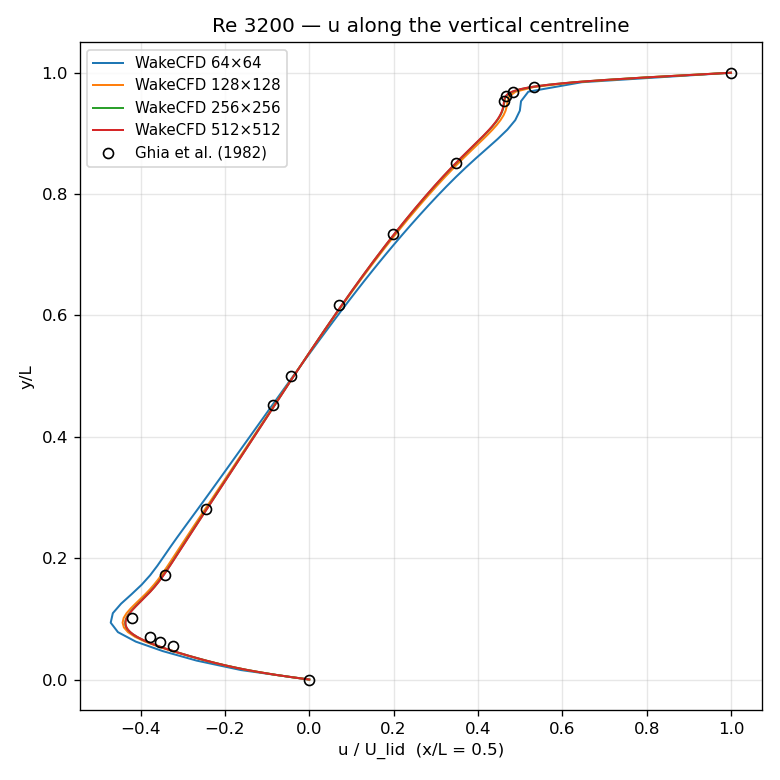
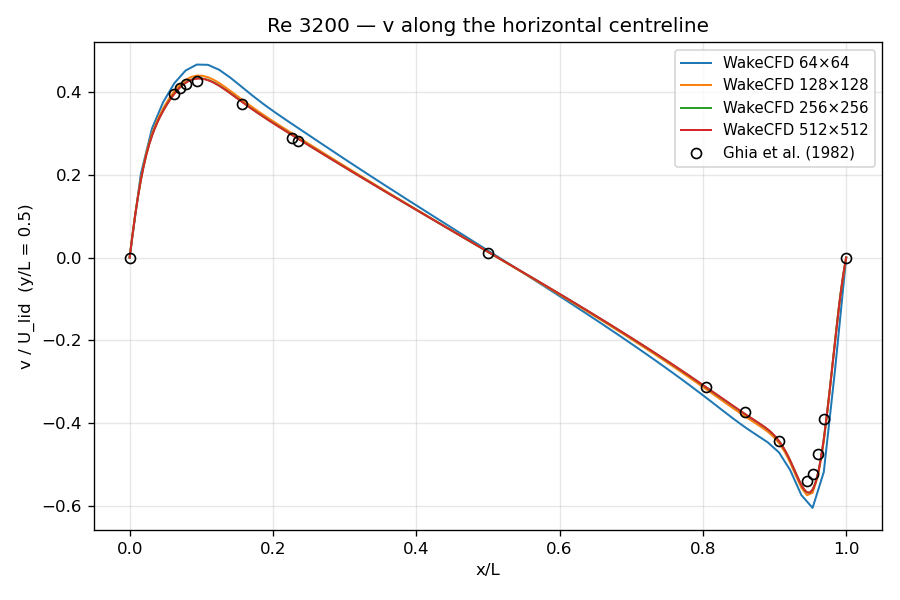
Wake CFD values were linearly interpolated to the reference coordinates. RMS errors exclude wall and lid points, which are prescribed by the boundary conditions. For \(Re=3200\), the reference \(u\) data use the corrected value at \(y/L=0.4531\). One \(Re=400\) reference \(v\) entry at \(x/L=0.9063\) is inconsistent with adjacent entries and is omitted from the RMS calculation; it remains marked with a red cross in the plot. The same comparison procedure was applied to every mesh.
The reference is a finite-resolution computation, so the RMS values measure agreement with that published dataset rather than error against an exact solution.
4 Simulation Conditions
| Item | Setting |
|---|---|
| Geometry | Square cavity with side length \(L=1\) |
| Flow | Steady, incompressible, laminar Navier–Stokes |
| Reynolds numbers | \(Re=100\), 400, 1000, 3200 |
| Normalization | \(U_\mathrm{lid}=1\), \(\rho=1\), \(\mu=1/Re\) |
| Reference pressure and temperature | 101,325 Pa and 300 K; temperature is not solved |
5 Mesh
Uniform square meshes were generated with Gmsh and extruded one cell through a span of 0.05. The mesh series used \(64^2\), \(128^2\), and \(256^2\) in-plane cells at every Reynolds number, with an additional \(512^2\) mesh at \(Re=1000\) and 3200. Symmetry conditions on the spanwise faces represent two-dimensional flow on a three-dimensional PBNS mesh.
6 Boundary and Initial Conditions
| Boundary or field | Setting |
|---|---|
| Top lid | Translating no-slip wall, \((u,v,w)=(1,0,0)\) |
| Left, right, and bottom walls | Stationary no-slip walls |
| Two spanwise faces | Symmetry |
| Initial field | Uniform zero velocity, pressure 101,325 Pa, temperature 300 K |
7 Numerical Methods
The runs used steady PBNS with automatic pseudo-time scaling (\(\Delta\tau=L/U_\mathrm{lid}=1\) for these settings) and line search. The linear solver was FGMRES with an AMG flow preconditioner, at most 50 linear iterations per solve, and a \(10^{-3}\) linear tolerance. The convergence criterion was a scaled flow residual of \(10^{-8}\) or lower, with a limit of 20,000 outer iterations. All 14 runs reached the residual criterion.
8 Results
The table reports the finest available mesh for each Reynolds number. RMS errors are normalized by the lid speed; the full 14-run results are in the downloadable summary.
| \(Re\) | Finest mesh | Outer iterations | RMS \(u/U_\mathrm{lid}\) | RMS \(v/U_\mathrm{lid}\) |
|---|---|---|---|---|
| 100 | \(256^2\) | 102 | 0.0025 | 0.0051 |
| 400 | \(256^2\) | 100 | 0.0012 | 0.0031 |
| 1000 | \(512^2\) | 126 | 0.0036 | 0.0099 |
| 3200 | \(512^2\) | 336 | 0.0147 | 0.0211 |
The centerline velocity profiles agreed closely with the reference points at all four Reynolds numbers. On the finest mesh, RMS differences ranged from 0.0012 to 0.0211 times the lid speed. At \(Re=1000\) and 3200, the \(256^2\) and \(512^2\) profiles nearly overlapped, while the coarsest meshes showed larger differences in regions of high shear.
8.1 \(Re=100\)
8.2 \(Re=400\)
8.3 \(Re=1000\)
8.4 \(Re=3200\)
8.5 Flow Patterns
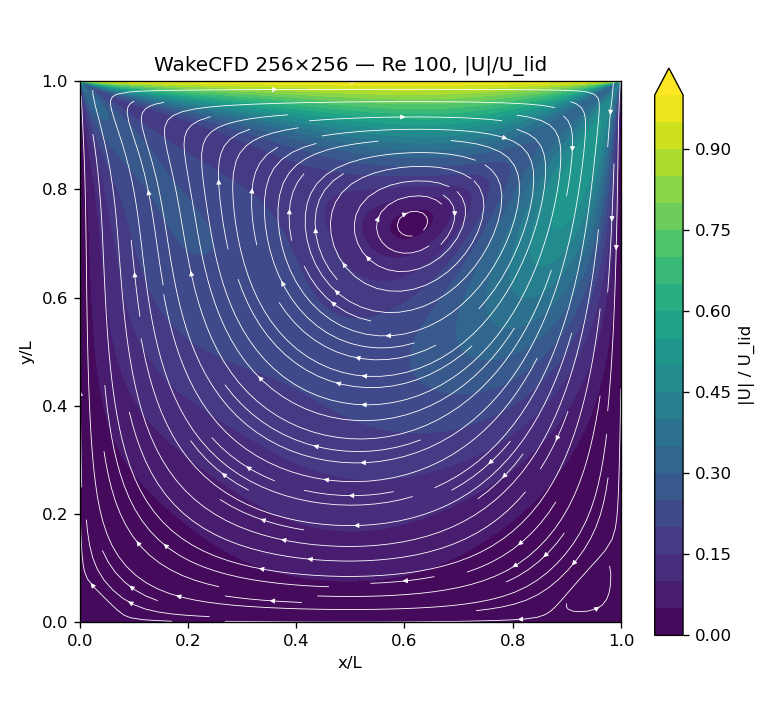
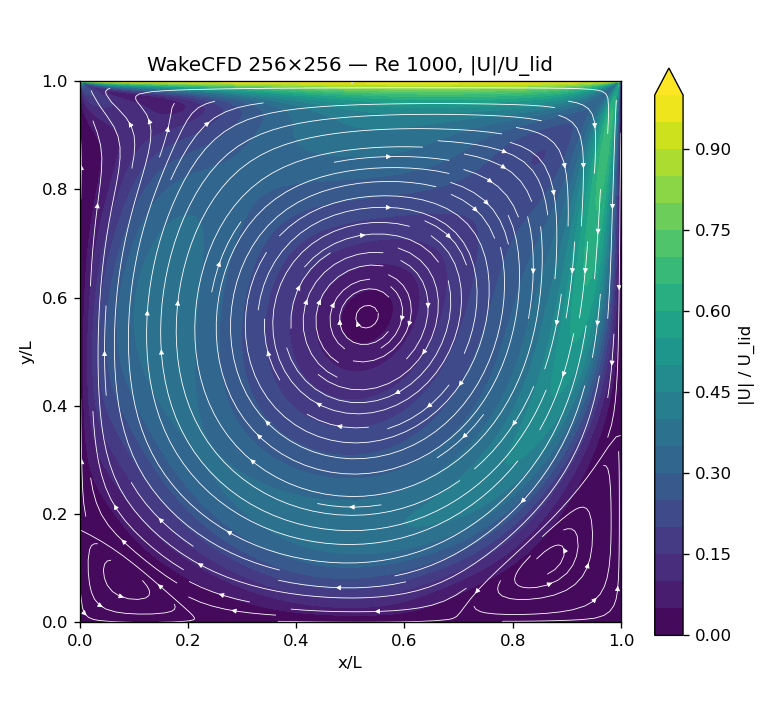
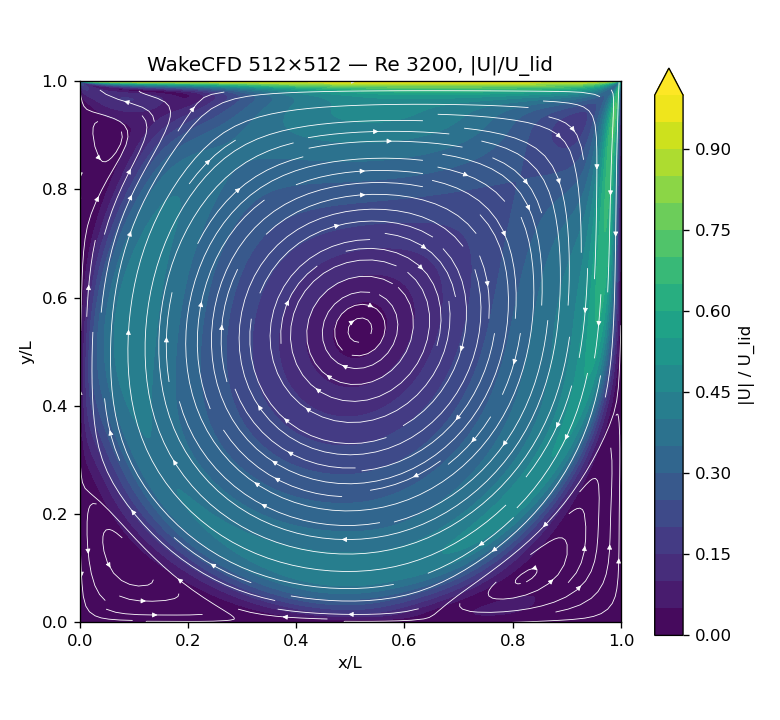
The computed streamlines show the primary cavity vortex and the smaller corner vortices as the Reynolds number increases.
9 Conclusions and Applicable Scope
For the stated steady, laminar cavity setup, all 14 PBNS runs met the specified residual criterion. The centerline velocities agreed closely with the numerical reference of Ghia et al. across \(Re=100\)–3200, with finest-mesh RMS differences of 0.12%–2.11% of the lid speed. The centerline profiles also tended to stabilize as the in-plane mesh was refined. These findings apply to the specified two-dimensional geometry represented by a one-cell spanwise extrusion, the stated Reynolds numbers, and boundary conditions.
10 References
- Ghia, U., Ghia, K. N., and Shin, C. T. “High-Re Solutions for Incompressible Flow Using the Navier–Stokes Equations and a Multigrid Method.” Journal of Computational Physics 48, no. 3 (1982): 387–411. doi:10.1016/0021-9991(82)90058-4.